YOUR COMPANY IS LOOKING FOR BUSINESS CREDIT FACILITIES!
THE ' OTHER' CHOICE FOR A LINE OF CREDIT
You've arrived at the right address! Welcome to 7 Park Avenue Financial
Financing & Cash flow are the biggest issues facing businesses today
ARE YOU UNAWARE OR DISSATISFIED WITH YOUR CURRENT BUSINESS FINANCING OPTIONS?
CONTACT US - OUR EXPERTISE = YOUR RESULTS!!
CALL NOW - DIRECT LINE - 416 319 5769 - Let's talk or arrange a meeting to discuss your needs
EMAIL - sprokop@7parkavenuefinancial.com
7 Park Avenue Financial
South Sheridan Executive Centre
2910 South Sheridan Way
Oakville, Ontario
L6J 7J8
"Cash is king, but liquidity is the kingdom. Without the ability to access capital when opportunity knocks, even profitable businesses watch growth pass them by." — Adapted from business financing wisdom
Business Revolving Line of Credit in Canada: What You Need to Know
Table of Contents
What Is Not a Business Line of Credit
Short-Term vs. Long-Term Financing
Day-to-Day Funding and Eligibility
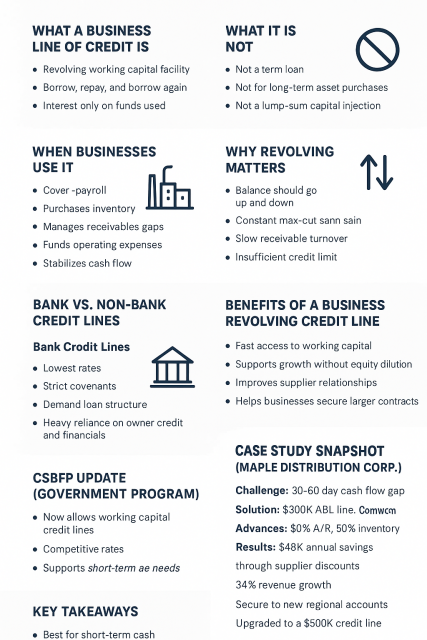
What a Business Line of Credit Is
Why Revolving Credit Matters
When a Loan Gets “Called”
The Rise of Non-Bank Credit Lines
Key Takeaways
Conclusion
FAQ
"The Cash Flow Gap That's Costing You Growth"
Your business is profitable on paper, but there's rarely enough cash in the bank when opportunities knock.
That contract requires upfront materials. Payroll hits before receivables clear. Seasonal dips create anxiety.
Let the 7 Park Avenue Financial team show you how a business revolving line of credit solves this timing problem by giving you instant access to working capital exactly when you need it—without the rigid structure of traditional loans.
3 Uncommon Takes
The Anti-Loan Loan: Most business owners think they need a loan when what they really need is permission to access their own future revenue. A revolving line of credit isn't borrowing in the traditional sense—it's smoothing out the natural peaks and valleys that exist in every business's cash conversion cycle.
Your Cheapest Employee: Calculate what it costs you to chase late-paying customers, miss early-payment discounts, or pass on bulk purchase savings. A revolving credit line often pays for itself by enabling financial efficiency that would otherwise require hiring a full-time treasury manager.
The Confidence Factor: The best time to secure a revolving line is when you don't desperately need it. Having unused credit capacity changes how you negotiate with suppliers, respond to opportunities, and sleep at night—yet most business owners wait until crisis mode to apply.
What Is Not a Business Credit Line
A business line of credit is not a term loan. Term loans come with fixed payments and set amortization schedules.
The exception is the updated Canada Small Business Financing Program (CSBFP), which now includes a working capital line of credit in addition to equipment, leaseholds, and real estate financing.
Short-Term vs. Long-Term Financing
A business line of credit should never be used to purchase capital assets. Equipment should be financed through a lease or equipment loan.
The rule is simple: match the financing term to the asset.
Using short-term borrowing for long-term assets drains working capital and leads to cash-flow stress.
Day-to-Day Funding and Eligibility
A business line of credit for secured and unsecured lines act like a company’s operating account. It supports day-to-day needs, not long-term investments.
This facility is often compared to a personal checking account, where funds move in and out constantly.
Strong turnover in receivables and inventory helps qualify for a larger credit limit.
What a Business Line of Credit Is
Many Canadian owners ask how to get approved for a business line of credit.
A credit line functions like an overdraft with a credit limit, not a lump-sum loan.
It lets companies draw funds when cash is tied up in receivables, inventory, or prepaid expenses.
A business line of credit provides:
Flexible access to working capital
Funding tied to operating assets
Interest only on the amount used
Why Revolving Credit Matters
The word “revolving” defines how lines of credit work. Banks expect balances to rise and fall with sales and collections.
If your balance is always maxed out, two problems may exist:
Slow A/R or inventory turnover
A limit too small for your growth needs
Revolving activity signals financial health to lenders.
When a Loan Gets “Called”
Bank credit lines are structured as demand loans.
This means the bank can request full repayment at any time on your SME/Small business line of credit
Healthy operating performance and clear fluctuations in balances help prevent this outcome.
Lenders often request three months of bank statements to review inflows and outflows in the business chequing account
The Rise of Non-Bank Credit Lines in Canada
Asset-based lines of credit (ABL) continue to grow in popularity.
These facilities monetize receivables, inventory, and equipment into one operating credit line.
They offer more liquidity and looser approvals compared to traditional bank lines.
Benefits of asset-based credit lines:
Higher borrowing limits tied to assets
Easier approval with fewer covenants
Reduced reliance on personal credit scores
Scalable as sales and assets increase
ABL interest rates are higher than bank rates but come with faster funding and more flexible structure.
Company: Maple Distribution Corp. (Wholesale Distribution)
Challenge: Maple Distribution struggled with a 30-day cash flow gap—paying suppliers in 30 days while offering 60-day terms to customers.
This limited their ability to buy inventory, strained supplier relationships, and caused them to miss early-pay discounts. When a national retailer offered a $500,000 annual contract with 90-day terms, their bank declined to increase the credit line due to delayed financial statements.
Solution: Through 7 Park Avenue Financial, Maple secured a $300,000 asset-based revolving line of credit with advances of 80% on receivables and 50% on inventory. The lender focused on receivable quality rather than perfect financials, giving Maple immediate working capital and a revolving structure tied to their sales cycle.
Results: Within six months, Maple captured 2% early-pay supplier discounts, saving $48,000 annually—over $30,000 more than their financing cost. They fulfilled the new national contract, gained two additional accounts, and grew revenue 34% year-over-year. Strong performance later qualified them for a $500,000 increased facility at better rates.
Key Takeaways
Business lines of credit differ from term loans.
The CSBFP now includes working capital credit lines.
Revolving activity depends on sales, collections, and asset turnover.
Banks and asset-based lenders offer competing solutions.
Pricing varies by lender type, credit quality, and facility size.
Conclusion
A business revolving line of credit remains one of the most valuable tools for managing cash flow.
If you want reliable working capital options, call 7 Park Avenue Financial—a trusted, experienced advisor in Canadian small-business financing.
We help owners secure the right business loans/credit solutions to support growth and daily operations.
FAQ: Frequently Asked Questions - Revolving Business Credit Lines
What is a revolving business line of credit?
A revolving business line of credit provides flexible access to funds in the business bank account for day-to-day cash-flow needs. Borrowers pay interest only on funds drawn
It works like a business credit card but is secured by receivables through a general security agreement.
Companies use it for payroll, expenses, and short-term working capital without minimum monthly payments.
What is the interest rate on a revolving line of credit?
Rates vary by lender type, credit strength, financial reporting quality, owner credit score, and facility size.
Banks offer the lowest rates, followed by commercial finance companies and asset-based lenders.
Stronger financials and faster asset turnover typically reduce borrowing costs.
Does the Canada Small Business Financing Program offer lines of credit?
Yes.
The CSBFP was expanded in 2022 to allow a portion of the loan to be used as a working capital line of credit.
Rates are competitive, and the program supports short-term cash-flow needs for eligible businesses.
Statistics on Business Revolving Line of Credit
Approximately 60% of Canadian small businesses report cash flow challenges as their primary operational concern, with timing gaps between payables and receivables cited as the leading cause.
Businesses with established revolving credit facilities demonstrate 23% higher revenue growth rates compared to similar companies without access to flexible working capital, according to Canadian Federation of Independent Business data.
The average Canadian small business faces a 42-day gap between accounts payable and accounts receivable, creating working capital requirements equivalent to 11-15% of annual revenue.
Traditional bank approval rates for revolving business credit have declined to approximately 22% for companies with less than five years operating history, driving growth in alternative lending markets.
Companies that capture early payment discounts through revolving credit access typically save 2-3% on cost of goods sold, translating to 18-36% annualized returns on the cost of financing.
Citations
Business Development Bank of Canada. "Working Capital: Understanding the Basics." BDC.ca. Accessed December 2, 2025. https://www.bdc.ca.
Canadian Federation of Independent Business. "Small Business Cash Flow Survey Results 2024." CFIB.ca. Toronto: CFIB, 2024. https://www.cfib-fcei.ca.
Government of Canada, Innovation, Science and Economic Development Canada. "Key Small Business Statistics 2024." IC.gc.ca. Ottawa: Innovation, Science and Economic Development Canada, 2024. https://www.ic.gc.ca.
Financial Consumer Agency of Canada. "Business Credit Products: A Guide for Business Owners." Canada.ca. Ottawa: Financial Consumer Agency of Canada, 2024. https://www.canada.ca.
Equifax Canada. "Understanding Business Credit Scores in Canada." Equifax.ca. Toronto: Equifax Canada, 2024. https://www.equifax.ca.
Canadian Bankers Association. "Small Business Banking in Canada: 2024 Industry Report." CBA.ca. Toronto: Canadian Bankers Association, 2024. https://www.cba.ca.
7 Park Avenue Financial." Business Credit Line Financing Asset Based Lending"https://www.7parkavenuefinancial.com/business-credit-line-financing-asset-based-lending.html
Medium/Stan Prokop." Business Lines of Credit Canada: The Ultimate Cash Flow Solution" .https://medium.com/@stanprokop/business-lines-of-credit-canada-the-ultimate-cash-flow-solution-5b79b773aaee
Substack."Comparing Business Credit Lines: Which One's Right for You?" https://stanprokop.substack.com/p/comparing-business-credit-lines-which